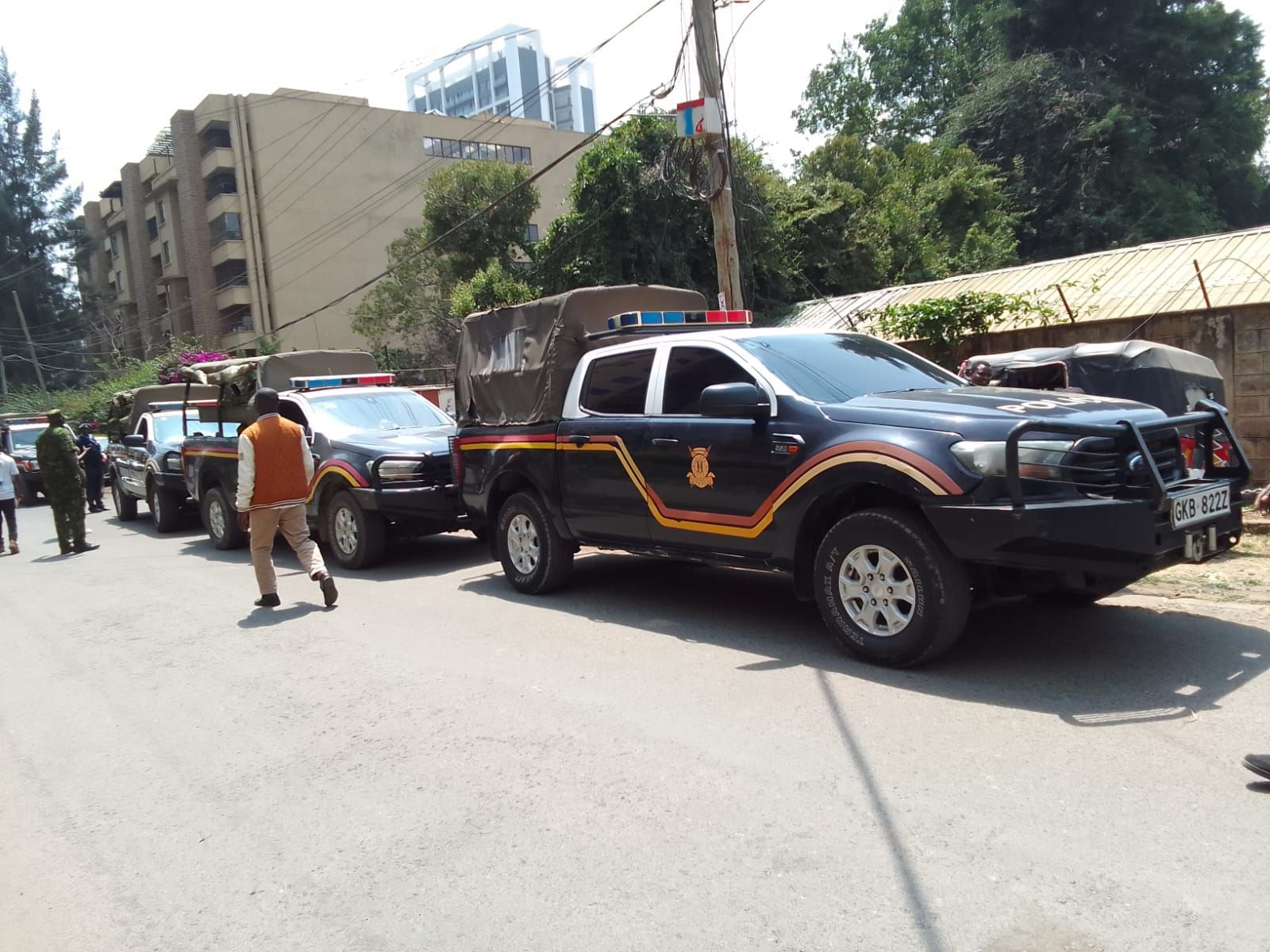
Security has been beefed up at the Burundi Embassy in Nairobi, with six police Land Cruisers deployed to the mission in addition to officers from the diplomatic police unit already stationed there.
Increased security measures at embassy
The heightened security comes as hundreds of Burundian nationals living in Kenya have flocked to the embassy seeking documentation, amid growing uncertainty over the government’s position on foreign nationals engaged in small-scale businesses.
A spot check by a Newsbooth reporter on Monday showed hundreds of Burundians gathered at the Embassy of Burundi on Dennis Pritt Road in Nairobi, with many seeking to process or update their travel and other documentation.
Earlier reports indicated that the Burundian Embassy had begun issuing emergency travel documents to Burundian nationals who are unable to use their passports.
The development has also seen some Burundian nationals seek documentation services outside the embassy, with several flocking to cyber cafés in Nairobi to process their papers.
At Dennis Pritt Road, a number of Burundians were seen lining up at a cyber café on Monday morning, carrying their identification cards, passports and other permits as they sought to complete the necessary documentation.
One Burundian, speaking on condition of anonymity, said they had been advised to obtain the necessary documents in preparation for possible travel back home.
The individual said they were processing their papers as a precaution amid uncertainty over the situation in Kenya.
Government directive on foreign nationals
The developments come amid growing tension and confusion following President William Ruto’s latest directive on foreign nationals engaged in small-scale businesses in Kenya.
Ruto directed authorities to begin shutting down small businesses operated by foreign nationals from Monday, September 7, arguing that hawking and small-scale retail activities should be reserved for Kenyans.
The President said the government would take administrative action as Parliament considers the proposed Local Content Bill, 2025, which seeks to address the participation of foreign nationals in certain trading activities.
He also directed National Assembly Majority Leader Kimani Ichung’wah and Trade Cabinet Secretary Lee Kinyanjui to accelerate the Bill’s passage through Parliament.
Elsewhere in Nairobi, tension has been reported at Kenyatta Market and Makina Market, where foreign traders have reportedly been confronted and asked to vacate their trading spaces.
A spot check in parts of the city also found some of the usual vendors missing from their regular locations.
Tea, mandazi, smokies and 'smocha' vendors — many of whom are foreign nationals — were notably absent from spots where they would ordinarily be found, amid uncertainty over how the government’s latest directive will be enforced.
Clarifications on enforcement actions
The government has separately emphasized that visa-free entry into Kenya does not give foreign nationals the right to work, trade or operate businesses without the necessary permits and licences.
Investment, Trade and Industry Cabinet Secretary Lee Kinyanjui said some foreign visitors had been using tourist and investor status to engage in activities that fall outside the conditions of their visas.
Kinyanjui said foreigners found violating immigration and work-permit requirements would have their visas revoked in accordance with the law.
He nevertheless said enforcement would be carried out in an orderly and transparent manner, while taking into account Kenya’s commitments under the East African Community.
The CS maintained that Kenya remains open to legitimate foreign investors and businesses that comply with the law and contribute to economic growth and job creation.
At the same time, Foreign Affairs Principal Secretary Korir Sing’oi has sought to clarify reports that President Ruto ordered a blanket crackdown on foreigners operating small businesses in Kenya.
Responding to a report by French publication Le Monde, Sing’oi said the President’s remarks had been taken out of context.
According to the PS, Kenya remains open to small- and large-scale trade by foreign nationals, provided they are properly documented and have the necessary approvals.
“We assure that small or large traders & employees of all nationalities, with requisite documentation — work permits & licenses — are legally protected to operate in Kenya,” Sing’oi said.
He added that Burundian nationals, East Africans and other Africans remain free to live and work in Kenya as long as they comply with the country’s laws.
Sing’oi’s clarification follows unease over remarks made by President Ruto on September 2, when he met Micro, Small and Medium Enterprises (MSME) traders at State House.
Ruto said some foreign nationals had established businesses selling merchandise and were competing directly with Kenyan hawkers and small-scale traders.
He pointed to a Bill before Parliament that would restrict foreign nationals from engaging in certain trading activities.
“We have a Bill in Parliament that there are some trading activities that foreigners can't do in Kenya.”
Ruto also drew a distinction between Kenya’s efforts to attract foreign investment and the arrival of foreign nationals to engage in small-scale retail and hawking.
With heightened security at the Burundi Embassy, hundreds of Burundian nationals seeking documentation, reports of foreign traders being confronted in Nairobi markets and conflicting interpretations of the President’s remarks, uncertainty remains over the scope and manner of the government’s enforcement action.
The immediate focus is now on how the directive will be implemented, whether affected foreign traders will be required to leave their businesses, and whether Parliament will move forward with the proposed Local Content Bill.